
Artificial Intelligence in Genealogy – Benefits, Limits and Risks
Artificial intelligence is playing an increasingly important role in genealogical research. On the one hand, laypeople are increasingly incorporating it into their research, while on the other hand, various major companies such as MyHeritage, FamilySearch, Ancestry, Geni and others use it to manage databases and connect individuals.
Companies offer a variety of tools based on artificial intelligence:
- tools for searching for ancestors in databases,
- tools for translating old documents,
- tools for improving old photographs,
- tools for writing stories.
As a layperson, you can use artificial intelligence primarily as an aid in your research, but by no means as a substitute for verifying sources.
How can you incorporate artificial intelligence into your research?
- Transcription of old documents – you photograph an entry, and artificial intelligence helps you read the old handwriting.
- Translation and explanation of terms – it explains Latin, German or old Slovenian terms.
- Distinguishing between individuals – it helps compare information about people with the same names.
- Analysis of documents – it extracts places, occupations, family relationships, witnesses, house numbers, etc.
- Connecting data – it helps establish possible connections between generations.
- Writing a family story – based on verified data, it can prepare an understandable narrative about your ancestors.
All tools based on artificial intelligence are often presented as an almost universal solution to our needs. Therefore, I decided, as a specialist, to test various tools of this kind myself.
My approach
For testing, I used documents that I am able to read and translate myself. This allows me to reliably assess the results produced by artificial intelligence.
I used different documents from different periods and in different languages. In this way, I wanted to ensure as broad a range of testing as possible.
I tested several platforms and tools and compared the results with one another.
Example 1 – Latin marriage record from the 18th century
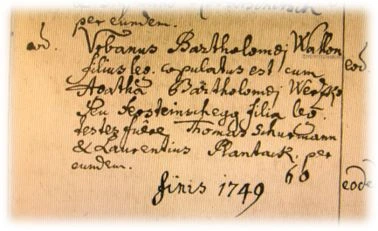
ChatGPT translation: Franz, [son] of Bartholomew Wal… legitimate son, born of/from … Anne, [daughter] of Bartholomew Wer… … daughter … witnesses were Thomas Sch… and Catharina Pann…, couple from … 6 b June 1749
Gemini translation: Urban, legitimate son of Jernej (Bartholomæus) Wallon, was married to Agatha, legitimate daughter of Jernej Weiss or Kepsteinschegg. The witnesses were Thomas Schurmann and Laurentius Rantack. By the same [priest]. End of 1749.
MyHeritage Scribe AI translation: on the same day. by the same. Urbanus Bartholomæj Wallon, legitimate son, married Agatha, legitimate daughter of Bartholomæus Weißka or Kopsteinschegga. The witnesses were Thomas Schurmann and Laurentius Rantack. by the same. End of 1749, 60, on the same day.
Claude translation: By the same [priest/clergyman]. Urban, son of Bartholomeus Walton [?], legitimate son, was married to Agatha, daughter of Bartholomeus Weiß [?] … Kosteinuheg [?], legitimate daughter. The witnesses were Thomas Schumann and Laurentius Plankart [?]. By the same. End of 1749.
Lampreht translation: Urbanus, legitimate son of Bartholomeus (B)Wallon, marries Agatha, legitimate daughter of Bartholomeus Werzkota, locally known as Fersteinschegg. The witnesses to the marriage were Thomas Schurmann and Laurentius Plantack. The same priest as in the entry above. End of 1749.
Example 2 – land register from the 19th century

ChatGPT translation: Kaschig Joseph, son in Kheros?
Gemini translation: 126 – House number or page number, 17 – Entry/day number, Zaischig Joseph – Joseph Zajc (Zajčig / Zaišig), Bauer in Zerovze – farmer in Žerovci (or Žerovce).
MyHeritage Scribe AI translation: Testing was not possible.
Claude translation: 126. [Sequential entry number]. 17. [Day of the month]. Joseph Zaischig (surname), farmer [?] in Zerovku [?] [or a place name with a similar spelling]. “Erg.” (Erg. may be an abbreviation, e.g. for “Erben” – heirs, or another abbreviation that cannot be reliably deciphered from the context.)
Lampreht translation: Building number 126, house number 17, Zaischig Joseph, farmer in Cerovec.
Example 3 – German marriage record from the 19th century
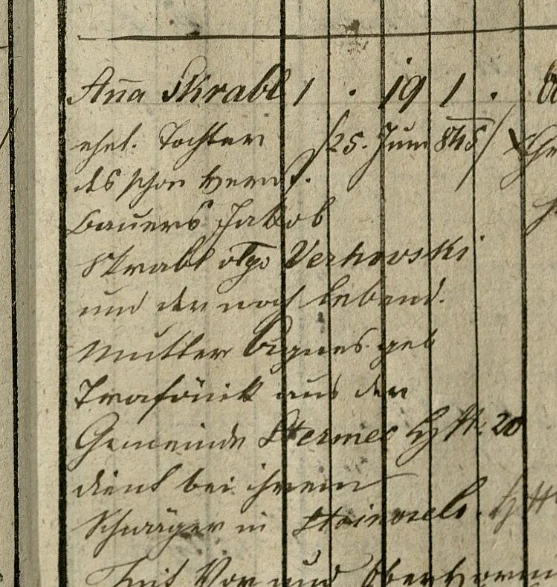
ChatGPT translation: Ana Strauch? … Joseph … 16 years … … residing … … in … … and … … farmers …… married …… municipality …… child …… born …
Gemini translation: Ana Škrabl (in the columns: 1 / 19 / 1), legitimate daughter | 25 June [1]845, of the late merchant/peddler/farmer Jakob Škrabl from Vrhovsko and the still-living mother Neža (Agnes), née Zveršinik, from the municipality of Šternjet [Sternec], district of St. [Veit/George…]. She works for her brother-in-law in Steinmetz (Kamnik / for a stonemason).
MyHeritage Scribe AI translation: Testing was not possible.
Claude translation: “Ana Skrabl. [Sequential no.] 1, house no. 19, [page/sequence no.] 1. [Born/baptized] 25 June 1845. Illegitimate daughter of the servant [name uncertain], locally known as (vulgo) Verhovski, and the still-living mother Eugenia, née Zwerschnik, from the municipality of Stermec [?], house no. 20. The child [remains/lives] with her … in the parish district in Steinwels [?].”
Lampreht translation: Anna Skrabl, 19 years old, born on 25 June 1845. Legitimate daughter of the late farmer Jakob Skrabl, locally known as Verhovski, and the still-living mother Agnes, née Trafonik. From the municipality of Sterme, she works for her brother-in-law in Stojno selo.
Example 4 – urbarium written in medieval German from the 16th century
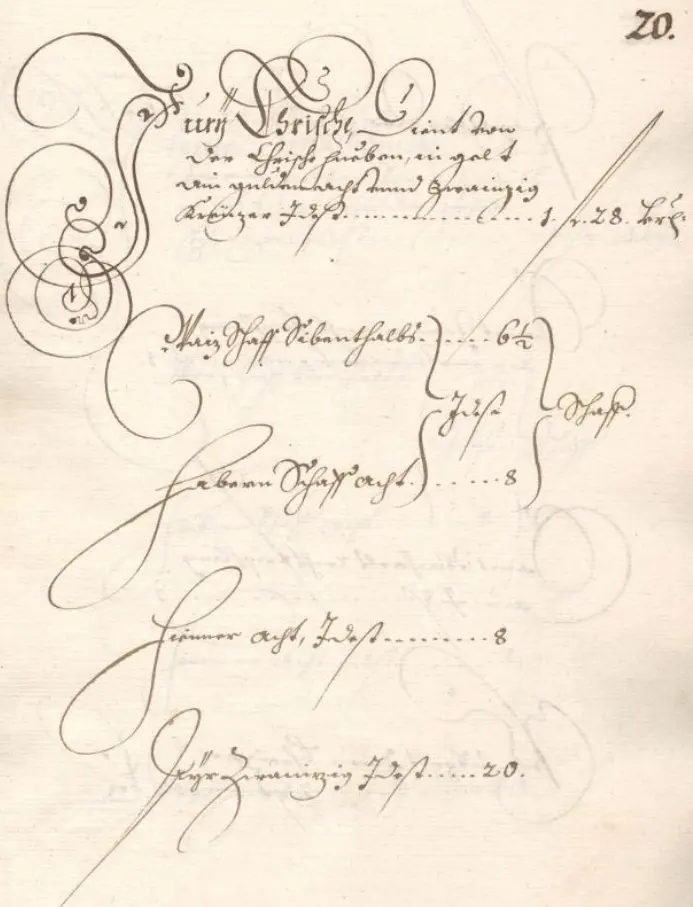
ChatGPT translation: …and fresh, something from … farmer, one …… learned … municipality …… fl. … 1 fl. 28 kr. Heiz … silverware … 6½ … horse … … 8… … … … 8… … … … 20
Gemini translation:
Page: 70, Beische [estate/farm or person] pays from the Jaram/Jarek of Beische:
one gulden and twenty-eight kreuzers, that is ………………… 1 fl. 28 kr.
Wheat: seven and a half Schäffel (bushels) …. 6 ½
Oats: eight Schäffel (bushels) …. 8
(Marginal note for wheat and oats: each bushel)
Lambs: eight, each …. 8
Kids: twenty, each …. 20
MyHeritage Scribe AI translation: Testing was not possible.
Claude translation: The page (numbered “20” in the upper right corner) contains a list of items with monetary amounts or quantities – most likely a record of agricultural dues paid in grain (wheat – Weizen, oats – Haber, “summer grain” – Sommergetreide), with each line ending in a number (e.g. 6½, 8, 8, 20), probably representing a measure or value in guilders/kreuzers (fl. = Gulden/guilder, kr./xr = Kreuzer).
Lampreht translation: Page 20, Jury Tsrische pays from his farm one gulden and twenty-eight kreuzers, six and a half bushels of wheat, one bushel of oats, eight chickens and eight eggs.
First of all, I would like to point out that I was unable to test MyHeritage Scribe AI on all of the documents because the use of the tool is restricted. For unlimited use, I would have to take out an annual subscription.
All the examples clearly demonstrate the limitations of artificial intelligence. In my test, all models and tools proved to be unreliable when performing individual tasks.
Now let us imagine, for a moment, a layperson who does not know the language and is using artificial intelligence to build their family tree, relying completely on the accuracy of its answers.
Will this layperson be able to identify the errors themselves? Certainly not.
What will the result be? Most likely, their family tree will contain incorrect individuals, information or connections.
It is important to understand that artificial intelligence can make mistakes or even “invent” information. Therefore, every important piece of information must be verified against the original historical source!
It is extremely important to understand that artificial intelligence is designed to provide the user with an answer. Therefore, it can also answer a question to which it does not have a reliable answer. And that is where the problem lies.
Artificial intelligence can translate a document even if it does not understand everything that is written in it. As a result, the user may receive a convincing but incorrect answer.
It is particularly concerning that an increasing number of genealogists are using artificial intelligence, or tools based on artificial intelligence, uncritically. With such an approach, a genealogist can quickly and cheaply construct a family tree, but at the expense of its accuracy. In the end, the client receives a family tree full of errors and, in the worst-case scenario, even fabricated information.
Therefore, my advice to everyone is: before you trust artificial intelligence, test it.
Choose old documents that you can read and understand yourself. Feed the documents into an artificial intelligence system and give it different tasks – for example, ask it to transcribe the text, translate it or analyse the document. In this way, you can determine for yourself how reliable its answers are and why caution is necessary when using it.
If you have obtained any information from a genealogist or from artificial intelligence, always ask for the source. Even better, ask for a copy of the original document. If you cannot read the document yourself, consult a specialist.
The greatest advantage of Dr. Lampreht lies precisely in his ability to read and understand the entire document and its historical context, something that automatic name searching alone cannot replace.
In addition to conducting research, Dr. Lampreht also translates and transcribes old documents.
Read more!
The translation test was conducted in August 2026.