
History of Ice Cream
The history of ice cream is closely connected with snow and ice. Snow and ice were already used in ancient times for cooling drinks and food.
The first people believed to have made ice cream were the Chinese. Around 700 BC, during the Tang Dynasty, they began mixing crushed ice with milk and rice.
The Romans mixed snow with honey, nectar, and fruit, creating a type of sorbet. Emperor Nero therefore sent his servants to the mountains to collect snow.
Around 400 BC, the Persians mixed ice with rice, fruit, and rose water.
The Greeks, including Alexander the Great, also mixed snow or crushed ice with honey and wine.
Gelato
In the 16th and 17th centuries, Italians developed gelato. Ruggeri, Buontalenti, and Coltelli were each important in their own way for its development.
Ruggeri created one of the first frozen desserts. Buontalenti improved the recipe by adding milk and eggs. Coltelli replaced honey with sugar and discovered the cooling effect of salt.
Coltelli later moved to Paris, where he opened the Café Procope. His guests are said to have included Voltaire, Balzac, Hugo, and even Napoleon.
Industrial Revolution
George Washington was a great lover of ice cream and spent considerable amounts of money on it.
Thomas Jefferson created his own recipe for vanilla ice cream.
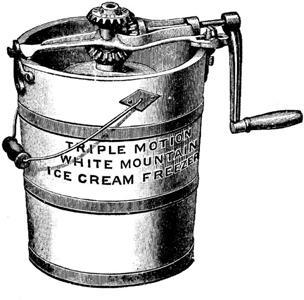
In 1790, the first ice cream machine was invented in America.
In 1843, Nancy Johnson patented the first ice cream maker for household use.
In 1851, Jacob Fussell opened the first ice cream factory in Baltimore, USA.
Ice Cream Cone
Originally, ice cream was served in glass cups. These were impractical because they broke easily.
Therefore, the Italian immigrant Italo Marchiony searched for a solution and patented the cone in 1903.
Popsicle
The American Frank Epperson made frozen lemonade drinks during the winter. He used a wooden stick for stirring.
In 1923, he accidentally left the mixture outside. When he returned, he discovered that it had frozen together with the stick. This is said to have been the birth of the ice pop.
Freezers
In 1913, the freezer was invented. With the spread of freezers during the 20th century, ice cream became available to a much wider public.
The Most Expensive Ice Cream
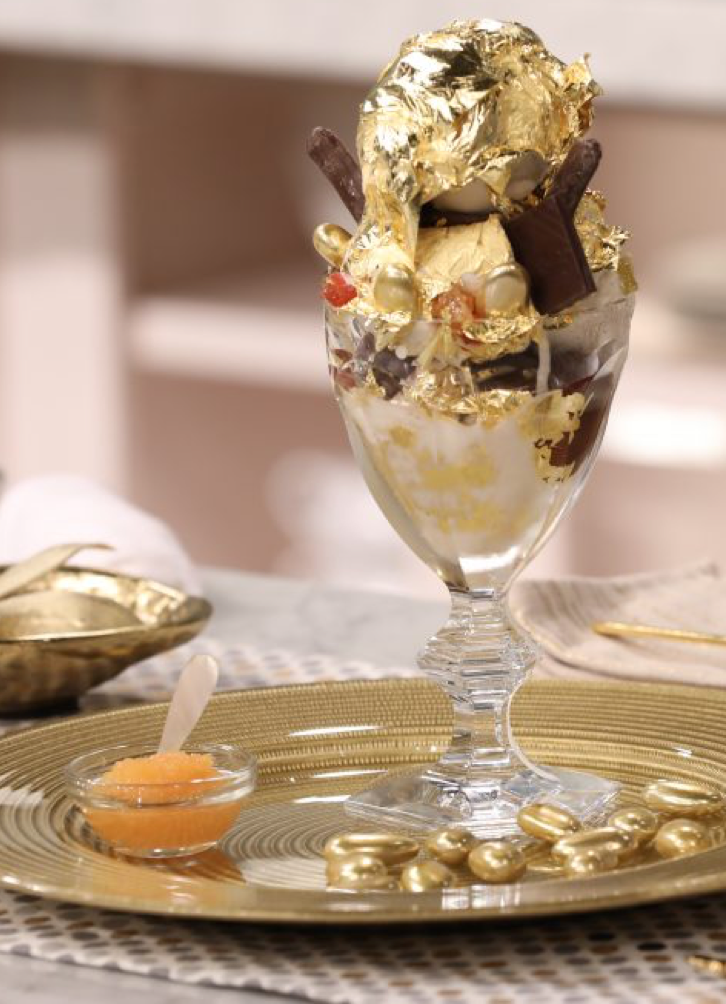
One of the most expensive ice creams in the world is the Golden Opulence Sundae.
The Golden Opulence Sundae is made from three scoops of rich vanilla ice cream made with Tahitian vanilla, enhanced with Madagascar vanilla, and covered with edible 23-karat gold leaf.
(Edible gold leaf is made from pure gold that is compressed or rolled into extremely thin sheets only a few micrometres thick, containing no other metals or impurities.)
The chocolate topping is made from melted Amedei Porcelana, one of the most expensive chocolates in the world. The dessert is additionally covered with pieces of rare Chuao chocolate, made from cocoa beans harvested along the Caribbean coast of Venezuela.
The ice cream sundae is then decorated with exotic candied fruits from Paris, gold-covered almonds (dragées), chocolate truffles, and marzipan cherries.
The dessert also comes with a small glass bowl of Grand Passion Caviar, an exclusive sweet “caviar” made from unsalted roe of the American golden sturgeon, known for its sparkling golden colour.
The caviar is sweetened and flavoured with fresh passion fruit, orange, and Armagnac.
Finally, the dessert is decorated with a gilded sugar flower and sprinkled with small flakes of edible gold.
The Golden Opulence Sundae is served in a Baccarat Harcourt crystal goblet worth approximately 350 US dollars, which the customer is allowed to keep.
The dessert can be enjoyed at the New York restaurant Serendipity 3, and the price is around 1,000 dollars.
Interesting Facts
During the Second World War, Americans also used ice cream to improve the morale of their soldiers.
New Zealanders consume the most ice cream, with approximately 28 litres per person per year.
The most popular ice cream flavour in the world is vanilla. Chocolate is in second place, and strawberry is third.
In Japan, you can try ice cream flavours such as wasabi, octopus, or horse meat.
In Slovenia, you can even find ice cream with the flavour of Kranjska klobasa (Carniolan sausage).
In the United States, there is an unofficial holiday called “Eat Ice Cream for Breakfast Day”, celebrated on the first Saturday in February.
Types of Ice Cream
Cream Ice Cream
Cream ice cream (also called egg cream ice cream) is made from at least 50% milk, and no water is used during production.
For every 1 litre of milk, the ice cream mixture must contain at least 270 g of whole egg or 90 g of egg yolk.
Ice Cream
Ice cream contains at least 10% milk fat and is mainly produced industrially.
Fruit Ice Cream
Fruit ice cream contains at least 20% fruit.
If it is made from citrus fruits or other acidic fruits with a citric acid content of at least 2.5%, it must contain at least 10% fruit, for example lemons, oranges, or passion fruit.
Fruit Ice Cream with Cream
Fruit ice cream with cream contains at least 8% milk fat and has a clearly noticeable fruit flavour.
This type of ice cream is also mainly produced industrially.
Semi-Frozen Dessert
A semi-frozen dessert (Halbgefrorenes) is a frozen dessert with a softer and less solid texture than ordinary ice cream.
Milk Ice Cream
Milk ice cream consists mainly of milk (at least 70%), which is sweetened with sugar syrup and flavoured with fruit purée or other ingredients.
Today, most ordinary ice cream is milk ice cream.
Cream Ice Cream (Sahneeis)
Cream ice cream (Sahneeis or Rahmeis) contains at least 18% milk fat from the cream used (whipped or liquid).
The cream is whipped during freezing in the ice cream machine, and sometimes egg yolks are added.
Because of its high fat content, it is especially creamy and aromatic. It can be used as a base for the same flavours as milk ice cream.
Cream ice cream and parfait are also used to make ice cream cakes and ice cream bombe desserts, for example the Fürst-Pückler cake.
Soft Serve Ice Cream
Soft serve ice cream is not considered a separate type of ice cream under ice cream regulations. It is a preparation method in which the ice cream mixture is simultaneously whipped and frozen.
Plant-Based Ice Cream
Creamy ice cream can also be made using plant-based milk alternatives, such as soy milk, almond milk, rice milk, or lupin milk.
Combined with frozen bananas and other fruit, ice cream can be prepared in a blender or juicer. This type of ice cream is known as nice cream.
Sorbet
Sorbet (also called fruit sorbet) is a frozen dessert or a thinner frozen preparation made from heavily sweetened fruit juice, sweet wine, or spirits.
Depending on the recipe, egg whites, whipped cream, or meringue mixture may also be added.
Its production is partly regulated by law.
Water Ice
Water ice consists mainly of frozen water and sugar.
It contains a maximum of 3% fat. The dry matter content from sweeteners and/or other flavouring ingredients must be at least 12%.
Water ice is mainly produced industrially.
Thomas Jefferson’s Vanilla Ice Cream
Ingredients
- 2 bottles (approximately 1 litre) of high-quality heavy whipping cream
- 6 egg yolks
- 225 g sugar
- 1 vanilla bean
Preparation
- Mix the eggs and sugar
In a bowl, whisk the egg yolks and sugar thoroughly until the mixture becomes smooth.
- Heat the cream
Pour the cream into a saucepan. Cut the vanilla bean lengthwise, scrape out the seeds, and add both the seeds and the pod to the cream.
Heat the cream over medium heat until it is just below boiling point.
- Tempering
Slowly pour the hot cream into the egg yolk and sugar mixture while stirring constantly, so that the eggs do not curdle.
- Thickening
Return the mixture to the saucepan and heat it over low temperature while stirring continuously until it thickens enough to coat the back of a spoon.
Do not allow it to boil.
- Straining and cooling
Strain the mixture through a fine sieve or cloth and allow it to cool completely.
- Freezing
Pour the cooled ice cream mixture into an ice cream maker and freeze until it reaches the desired creamy consistency.
Myths Related to Ice Cream
Marco Polo brought ice cream to Europe
A legend claims that Marco Polo brought a recipe for ice cream from China to Europe.
This is a popular story, but there is no historical evidence to confirm it. Frozen desserts already existed in Europe before his time.
The ice cream cone was invented because of a shortage of cups
According to a popular story, an ice cream seller at the Louisiana Purchase Exposition world fair in 1904 ran out of serving cups.
A waffle seller is said to have helped him by rolling a waffle into a cone shape, creating the ice cream cone.
It is a charming story, but it has not been fully confirmed. There are several different accounts of how the cone was invented.
Margaret Thatcher invented soft serve ice cream
A common story claims that British Prime Minister Margaret Thatcher invented soft serve ice cream.
It is true that, before entering politics, Thatcher worked as a chemist in the research laboratory of a food company.
However, soft serve ice cream already existed before she worked there, so she cannot be considered its inventor.
Source
Die Ursprünge und Geschichte des Gelato, Venchi.com, 03.08.2026
Eiscreme: Eine Kunst durch die Geschichte, Silikomart.de, 03.08.2026
8 Meilensteine in der Eiscreme-Geschichte, Benjerry.de, 03.08.2026
Claudia Kracht, Geschichte der Eiscreme, Planet-Wissen.de, 03.08.2026
Die Geschichte der Eiscreme: Von den Ursprüngen bis zur Gegenwart, Gelatomargherita.swiss.de, 03.08.2026
Taste Test! Thomas Jefferson’s Vanilla Ice Cream Recipe, nielsenmassey.com, 03.08.2026
A Scoop of History: Nancy Johnson’s Ice Cream Revolution, museumoficecream.com, 03.08.2026
Emmie Martin, This opulent sundae costs $1,000 — here’s what’s in it, CNBC, 03.08.2026
Our history, serendipity3.com, 03.08.2026
More about DIY Family Tree.